Building connections for AU-EU Science, Technology and Innovation Collaboration
On 25 August 2026, UniPID brought together experts from universities, research funding, policymaking and international research cooperation for the webinar AU-EU Science, Technology and Innovation Collaboration for Finnish Universities. The event explored how Finnish universities can engage with the growing landscape of African Union-European Union science, technology and innovation (STI) cooperation, from policy frameworks and funding opportunities to the practical work of building sustainable research partnerships.
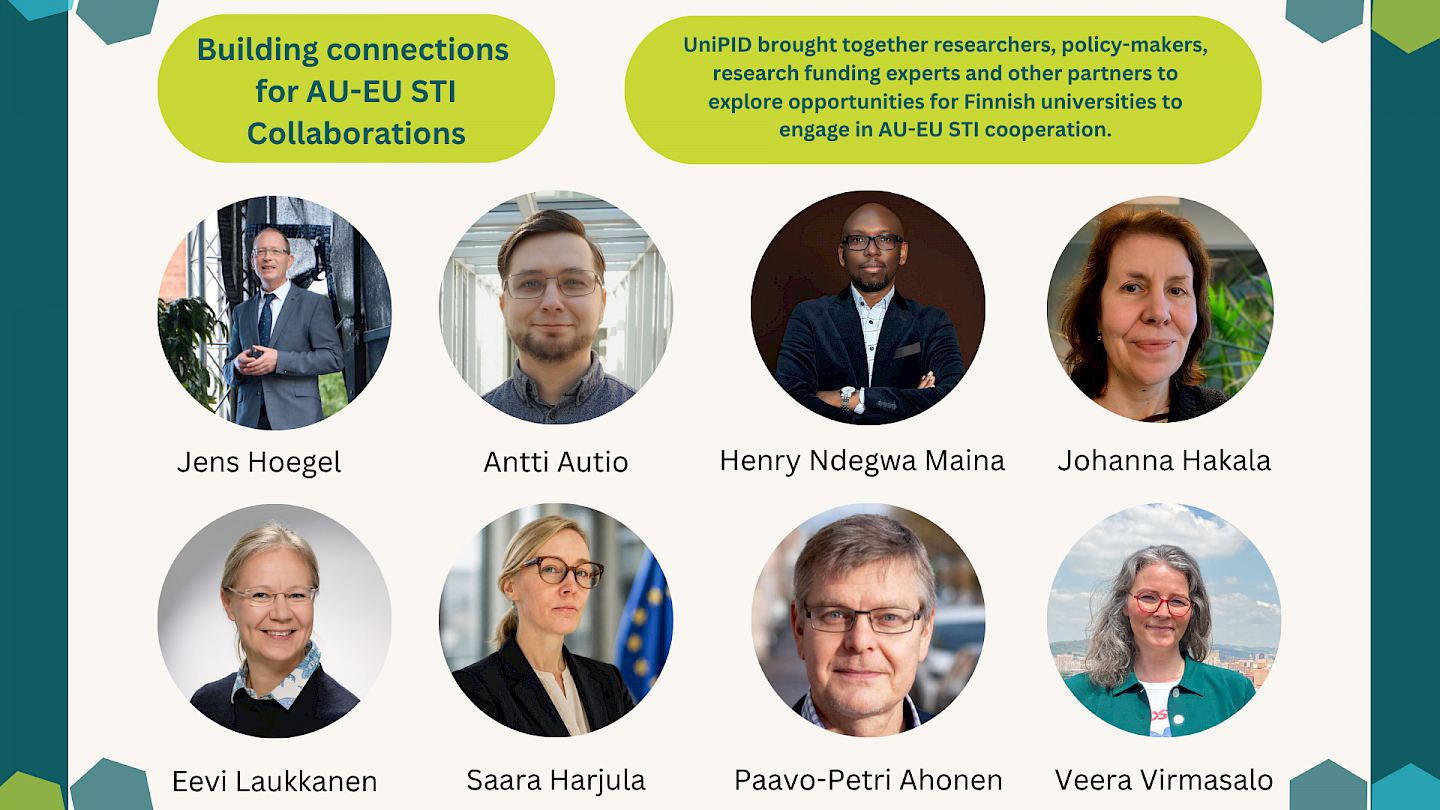
The UniPID webinar brought together perspectives from across the research and innovation ecosystem. Speakers included Jens Hoegel, Team Leader, Resilience, Infrastructure and Productive Sectors at the European Commission’s Directorate-General for Research and Innovation; Antti Autio, Specialist in EU-AU science and innovation partnerships at UniPID; Henry Ndegwa Maina, Associate Professor and University Lecturer at the University of Helsinki; Johanna Hakala, Senior Science Adviser at the Research Council of Finland; Eevi Laukkanen, Research Manager at the University of Eastern Finland; Saara Harjula, EU Liaison Manager at the University of Helsinki; Paavo-Petri Ahonen, Senior Ministerial Advisor at the Ministry of Education and Culture; and Veera Virmasalo, Senior Specialist in Higher Education and Science Policy at the Embassy of Finland in Pretoria.
The event was facilitated by Kaisa Kurki, Director of UniPID, and concluded with reflections from Minna Tanskanen, Vice Dean at the Faculty of Social Sciences and Business Studies at the University of Eastern Finland. In her closing remarks, Tanskanen reflected on the importance of connecting policy priorities and funding opportunities with practical, long-term cooperation between Finnish and African higher education institutions.
Across the presentations, participants heard about the broader AU-EU STI policy framework, Finland’s role in AU-EU initiatives, experiences from past and ongoing projects, upcoming Horizon Europe opportunities, university advocacy efforts and perspectives from Southern Africa.
Yet, despite the range of topics and organizations represented, one message emerged particularly strongly: successful AU-EU collaboration is about much more than finding the right funding call. It requires engaging early, building relationships, and investing in partnerships that can continue beyond an individual project.
From policy priorities to concrete opportunities
AU-EU cooperation in research and innovation has developed considerably since the establishment of the High-Level Policy Dialogue on Science, Technology and Innovation in 2010.
Jens Hoegel from the European Commission introduced participants to this broader policy landscape and the Joint AU-EU Innovation Agenda. The agenda aims not only to support research and researchers but also to translate research and innovation into tangible societal and economic outcomes. Among its objectives is the development of sustainable, long-lasting and mutually beneficial higher education and research partnerships between the two continents.
But how do these high-level frameworks translate into something useful for researchers or universities?
Antti Autio approached this question from the perspective of Finnish universities. Policy priorities shape programmes and initiatives, which in turn create networks and cooperation structures. These structures can eventually generate opportunities for research projects, mobility, education, policy engagement, and innovation.
The difficulty, Autio noted, is often not the absence of opportunities but “knowing where to connect and knowing early enough.”
Finland also has considerable experience to build on. In the field of food and nutrition security and sustainable agriculture (FNSSA), data presented during the webinar identified 48 projects involving Finnish actors, with a combined value of around EUR 149 million. Nineteen of these projects have been coordinated by Finnish institutions.
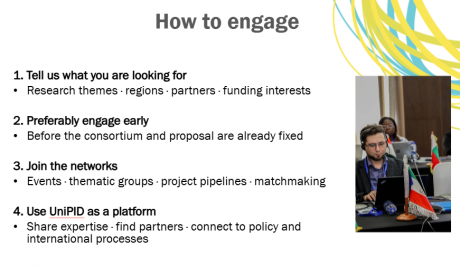
Importantly, participation in AU-EU cooperation does not have to begin with a major funding proposal. Researchers and universities can engage through research and innovation projects, education and capacity development activities, mobility, policy processes, science diplomacy, and thematic networks. As highlighted during the webinar, engagement extends far beyond funding calls, and long-term networks often provide the foundation for future projects.
Partnerships are built, not found
Perhaps the clearest illustration of this message came from Henry Ndegwa Maina, who reflected on his own journey in building international research collaboration around sustainable food systems.
Rather than beginning by coordinating a large project, Maina described a gradual process involving smaller and more focused funding instruments, network activities, collaborative roles in international consortia and, importantly, unsuccessful applications along the way. These experiences provided valuable understanding to learn about different funding mechanisms while simultaneously developing relationships, trust, and deeper knowledge of local research contexts.
Looking ahead
As AU-Eu cooperation continues to expand, new opportunities are emerging for Finnish universities to engage in research, innovation, higher education and policy dialogue. The webinar demonstrated that while navigating the complex landscape of funding schemes, there are a range of support structures, networks and mechanisms already in place to help get involved.
Through its long-standing work in international higher education cooperation, advocacy, partnership facilitation and knowledge exchange, UniPID serves as an important bridge between Finnish universities and African partners, helping to connect institutions with emerging AU-EU collaboration opportunities and networks.
Successful collaboration is not only about resources. It is also about partnerships and developing them so that they are built on mutual understanding and trust in order to create sustainable and long-lasting impact across both continents.