
During the first DocShop of the year, held as part of the DevDays2026 conference, DocNet members were invited to reflect on how rapid political, economic, and institutional shifts are reshaping the conditions and career pathways of development research, and how to navigate the challenges of a rapidly evolving sector. If you missed the workshop or are simply curious about the topic, here is a summary of the main takeaways the session offered.
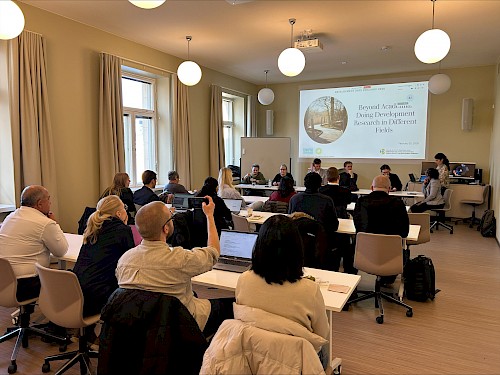 Aligned with this year’s Development Days conference theme, “Development in ruins, hope in the cracks,” UniPID and the FSDR brought together doctoral researchers, supervisors, and practitioners from across government, civil society, academia, and the private sector. The aim was to explore how current political, economic, and institutional shifts are reshaping development research, and to reflect on what it means to build meaningful careers at a time when both the sector and the world it seeks to understand are rapidly transforming.
The workshop was structured in two main parts. First, we were honoured to host a panel discussion on “Doing Development Research Within and Beyond Academia” with Heini Vihemäki (Funding Advisor, LUT University), Axel Sointu (Manager, Partnerships at Finnpartnership), Nea‑Mari Heinonen (Lead Evaluation Specialist and Deputy Director, Development Evaluation Unit, Ministry for Foreign Affairs of Finland), Maaria Seppänen (Consultant in Development Cooperation Evaluation), Outi Hakkarainen (Policy Adviser for Global Justice at Fingo), and Joni Valkila (Director, Uskontojen Uhrien Tuki – Support for Victims of Religion). The discussion was facilitated by Judith Kahamba (Postdoctoral Researcher in Development Studies).
After the panel, speakers and DocNet members continued the conversation in small-group reflection sessions, where participants exchanged concerns, experiences, and perspectives related to the evolving landscape of development research.
The discussion was structured around three guiding questions. Below is a synthesis of the conversation and its key insights, highlighting the evolving landscape of development research, the emerging opportunities across sectors, and the skills increasingly essential for future professionals in the field.
The Changing Terrain of Development Research
The panel stressed that discussions on this topic are needed since the development sector, as well as the concept of “development” itself, is undergoing significant reconfiguration. Panelists described a landscape marked by funding volatility, shifting government priorities, and growing pressures linked to geopolitics and national security. The move toward a stronger private-sector role -often framed as a shift from aid to trade- is influencing research agendas, grant structures, and the kinds of partnerships considered viable.
These changes do not diminish the need for critical scholarship. On the contrary, they underscore how essential it is. Yet conducting such research now requires navigating institutional sensitivities, political ambiguity, and concerns about researcher safety. Participants noted that career paths are becoming less linear: researchers increasingly move across universities, NGOs, government, and private initiatives, building resilience through flexibility rather than long-term institutional stability.
Expanding Spaces for Engagement
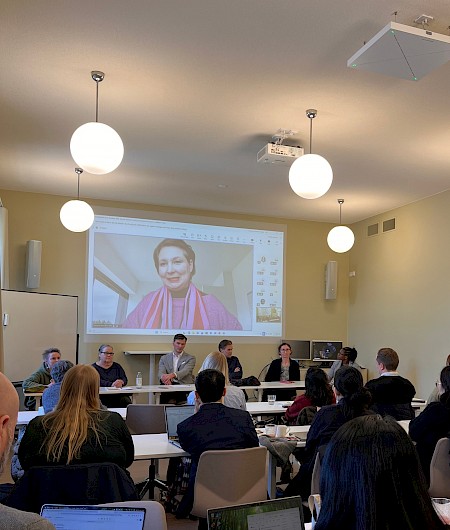
The panelists acknowledged that even within a turbulent funding environment, meaningful opportunities exist across and beyond academia. Research programmes aimed at societal impact provide openings to combine academic work with engagement in public policy, evaluation, and teaching. Universities continue to offer spaces for collaboration through platforms such as Open University and UniPID, which connect researchers across disciplines and institutions.
Outside academia, careers often unfold at the intersection of NGOs, public-sector bodies, multistakeholder initiatives, and sometimes the private sector. Many panelists emphasized that moving between the different fields within and beyond academia, is not only common but enriching. NGO and civil society work remains a significant field for research expertise, though increasingly competitive. Diplomacy training programmes and consultancy roles also feature in the broader landscape, though they often require strong experience, networks, or specialized profiles.
The overall picture is one of diverse but unevenly distributed opportunities. Rather than pursuing a single, linear path, researchers should build careers that blend teaching, applied research, policy influence, and short-term project work.
The Skills Shaping Tomorrow’s Development Professionals
Across sectors, the skills most valued today combine analytical depth with strong communication and interpersonal abilities. Methodological versatility, ranging from qualitative techniques to mixed-methods designs and familiarity with AI tools is highly sought after. Panelists also stressed the importance of futures-oriented thinking: the ability to look beyond immediate challenges and anticipate emerging trends.
Communication is equally critical. Researchers must translate complex ideas into accessible insights for policymakers, communities, funders, and private-sector partners. This requires clarity, adaptability, and an understanding of institutional incentives. Soft skills, such as active listening, facilitation, and cross-cultural collaboration were consistently highlighted as essential for working in multi-stakeholder settings.
As development cooperation increasingly follows project and investment logics, management competences have also grown in importance. Skills in project design, budgeting, monitoring, and implementation can significantly strengthen a researcher’s professional profile. Strong networks, international experience, and credible public engagement help researchers remain visible and relevant across a rapidly shifting sector.
Looking Ahead: Holding Space for Critical Research
The workshop closed with a reflection made by Karim Maiche (University lecturer at the Faculty of Social Sciences in the University of Lapland) on the broader implications of these trends. Political instability, economic uncertainty, and funding pressures are not abstract; they shape how researchers imagine their futures and the types of knowledge that can be sustained. Yet moments of upheaval also bring new openings. Private companies, philanthropic actors, and hybrid partnerships are creating fresh spaces where development researchers can contribute meaningfully, provided they engage with integrity and avoid reducing research to narrow economic interests.
What the sector needs, as several speakers noted, are people who can bridge worlds: researchers who can carry critical research into policy, practice, and organisational decision‑making without becoming opportunistic. Adaptability, creativity, and a willingness to work across institutional boundaries will be essential as development continues to evolve.
**
Curious to dive deeper into the panel discussion? You can watch the full recording here and revisit the reflections, debates, and insights shared during the session.
If you’d like to continue conversations like this, connect with peers, and stay informed about upcoming DocShops and events, we warmly invite you to join our DocNet community here.
Photo credits: K8, 2020 on UnSplash