Responsible Project Management Starts with Relationships - Reflections from UniPID Annual Seminar 2026
On 10 November 2026, the UniPID Annual Seminar brought together researchers, project professionals and partnership practitioners to explore a question that is becoming increasingly important in higher education institutions: What does responsible project management look like in global academic partnerships?
At first glance, project management may seem primarily concerned with timelines, budgets, reporting structures, and deliverables. Yet throughout the seminar, invited speakers encouraged participants to look beyond administrative processes and examine how projects can be designed and implemented in ways that are genuinely equitable, mutually beneficial, and responsive to the diverse contexts.
As universities increasingly rely on project-based collaboration to address global challenges, the quality of partnerships themselves becomes a critical part of project success. Responsible project management is therefore not only about managing resources effectively and delivering cutting-edge science. It is also about creating the conditions for trust, shared ownership, and meaningful participation.
In the UniPID Annual Seminar, speakers emphasized that international partnerships require continuous attention to how decisions are made, how responsibilities are shared, and whose voices are included throughout the project cycle. While projects may have clearly defined objectives and measurable outcomes, successful collaboration is ultimately built on relationships grounded in mutual respect and reciprocity.
Looking beyond project structures
The keynote addressed by Dr. Divinia Jithoo from Cape Peninsula University of Technology challenged participants to view partnerships not simply as contractual arrangements but as human relationships rooted in shared responsibility and recognition of our interconnectedness. Drawing on the philosophy of Ubuntu, she argued that responsible project management begins by asking three deceptively simple questions: Who decides? Who carries the costs and risks? Who benefits, both during and after the project? Examining these questions can reveal assumptions and power dynamics that often remain hidden within project structures.
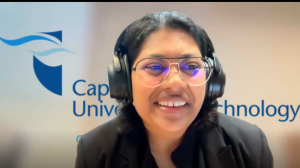 Drawing on research from South Africa, Jithoo showed how international partnerships continue to be shaped by funding structures, institutional hierarchies, and historical power relations. While partnerships between institutions in the Global North and Global South have expanded significantly, equitable participation remains an ongoing process rather than an achieved outcome.
At the same time, Jithoo cautioned against treating North and South as fixed categories:
"Global North and Global South is a useful shorthand for structural inequality. Ans we do use it that way but it is also not a fixed map. And it can hid as much as it shows. -- It obscures national, regional and institutional complexities. There are Norths within the South, souths within the North and actors that fit neither."
Her message highlighted the need for more nuanced approaches to understanding power and responsibility in international collaboration.
Exploring equity in practice
The panel discussion brought together Sifeddine Labed, Research Director at the Renewable Energy Development Center (CDER), Algeria; Apoorwa Hooda, Grant Researcher and former India Coordinator at the University of Jyväskylä; Sai Väyrynen, University Lecturer and former lead of the GINTL network at the University of Helsinki; Sari Havu-Nuutinen, Professor at the School of Applied Educational Science and Teacher Education, University of Eastern Finland; and Dipjoy Chakma, Project Planner at Viikki Tropical Resources Institute (VITRI), University of Helsinki.
Across different professional contexts and partnership experiences, panelists returned to same theme: discussions about equity, inclusion, and shared ownership cannot be separeted from the colonial histories and strucutral inequalities that continue to influence contemporary global research collaboration.
This prompted also a further question: What does it mean to decolonize project management in practice?
While no single answer emerged, the conversation encouraged participants to critically examine their own partnerships structures, decision-making processes, and assumptoins about expertise and leadership. Decolonizing project management may begin with listening more carefully, questioning established assumptions, and creating space for different forms of expertise, knowledge, and leadership.
A recurring concern was the tendency for projects to become more responsibe to donor priorities tahn to the needs and aspirations of local institutions and communities. As Sifeddine Labed noted:
"Many partnerships weaken once extended funding and because of insufficient attention was given to institutional embedding, local financing and long-term governance."
The discussion also highlighted the importance of transparency. Building strong partnerships requires honest conversations about expectations, institutional interests, funding conditions, and desired outcomes. Such discussions may at times be challenging, but they create the foundation for trust and help ensure that the partnership serves all those involved.
Dipjoy Chakma pointed to a common challenge in externally funded projects:
"Funding rules may require Northern institutions to lead coordination, financial management, and reporting. However, that should not mean that all important decisiona re made solely by the coordinating institution. Shared leadership and decision-making are essential."
From values and principles to concrete practices
While structural challenges are not always easy to overcome, panelists identified several practical approached that can strengthen equitable partners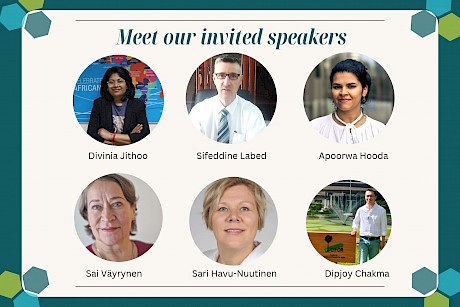 hips. These included co-leadership arrangements, shared decision-making processes and structures, collaborative budget planning and investments in project management capacity across institutions.
The discussion also highlighted the value of funding models that allow time for partnership building before project implementation begins. Reflecting on the experiences of the GINTL network, Sai Väyrynen emphasised the importance of flexibility:
"We were able to spend time on getting to know our partners and building the partnership before actually working on planning of the project. That was exceptional and something that I would really like to see in the higher education funding for international collaboration."
Similarly Apoorwa Hooda encouraged participants to be transparent about the motivations behind funding relationships:
"We should ask why are the Northern partners funding projects with the Global South and to be open about the purposes and expectations behind these collaborations."
Perhaps one of the key messages from the seminar was that meaningful partnerships require time. Building trust takes time. Understanding institutional context and the expectations and motivations of the partner takes time. Creating shared goals take time.
Sari Havu-Nuutinen illustarted this through a collaborative training programme in which responsibilities were shared across the partnership:
"Together we created materials that none of us wouldn't be able to do alone.Sharing responsibilities helped highlight the expertise and knowledge that already existed within the team."
What comes next?
As the seminar concluded, participants shared a common understanding that responsible project management is not simply a technical competence. It is a continuous process of reflection on power, relationships, responsibilities and impact. Building just and equitable partnerships requires much more than efficient administration. It requires the willingness to question whose voices are heard, whose priorities shape project agendas, and whose knowledge is valued.
In a world where global challenges increasingly demand international cooperation, responsible project management offers an opportunity not only to improve project outputs and scientific impact but also to transform the way partnerships are conceived and practised. The conversations at the UniPID Annual Seminar suggest that more equitable collaboration is possible, but achieving it requires intentional effort, openness to change, and a commitment to learning together.
UniPID will continue this conversation by developing a discussion paper based on the insights shared during the seminar, and inviting contributions from researchers, educators, and project professionals committed to building more equitable forms of international collaboration. The aim is not only to reflect on current practices but also to identify concrete actions that can help make responsible and equitable partnership reality. Stay tuned!
In the meantime, you can revisit UniPID's Ethical guidelines for responsible academic partnerships with the Global South.
Latest posts